Understanding Concrete Moisture Vapor Transmission Rates for Long-Lasting Floor Coatings
When you install a new floor coating, you must consider what happens beneath the surface. High Concrete moisture vapor transmission rates can quickly destroy a substandard floor coating by forcing water vapor upward through your porous concrete slab. We know that managing this hidden subterranean pressure is the single most important factor for a successful floor installation. At Floortek Coatings, we specialize in advanced polyaspartic systems designed to handle the toughest moisture challenges throughout Texas.
What Are Concrete Moisture Vapor Transmission Rates?
Concrete looks completely solid to the naked eye. However, concrete is actually a highly porous material, much like a dense sponge. It contains thousands of microscopic capillary pathways formed during the original mixing and curing process. Concrete moisture vapor transmission rates measure the volume of water vapor that passes through these capillary networks over a specific timeframe. This measurement is usually calculated as pounds of water vapor escaping from 1,000 square feet of concrete over 24 hours.
When you apply a topcoat to your concrete, you seal those pores. If the moisture emission rate is too high, vapor gets trapped directly beneath the coating. This trapped moisture creates continuous upward pressure. Over time, this pressure breaks the bond between the coating and the concrete slab. Understanding these transmission rates allows us to design a floor system that remains fully bonded for decades. Our team balances the underlying floor chemistry before we ever apply a finish coat. You can learn more about our process by reviewing our About Us page.
The Technical Science Behind Sub-Slab Moisture Migration
Moisture moves through a concrete slab due to two primary forces: capillary action and vapor pressure differentials. Capillary action occurs when liquid water from the soil beneath your slab rises through the pores in the concrete. Vapor pressure differentials occur when the temperature or humidity inside your building is lower than that in the ground. The laws of physics dictate that moisture will always move from an area of high humidity to an area of low humidity.
As the liquid water travels upward, it eventually evaporates into a gas. This gas is called moisture vapor. If you want to dive deep into how these gases interact with modern floor systems, read our technical breakdown on the Chemistry of polyaspartic coatings. When this vapor meets an impermeable topcoat, it cannot escape into the air. The vapor condenses back into liquid water, gathering at the bond line. This accumulation creates an osmotic cell, drawing alkaline salts from the concrete and creating a highly destructive environment for standard floor finishes.
Why Traditional Epoxy Fails Under High Vapor Pressure
Epoxy coatings are our main competitors, but they struggle significantly in high-moisture environments. Traditional epoxy forms a rigid, brittle cross-linked structure over the concrete. While it looks tough, it does not tolerate vapor pressure well. When vapor pressure builds underneath an epoxy coat, the brittle material cannot flex or absorb the stress. Instead, the pressure forces the epoxy to detach from the slab, causing unsightly bubbles, blisters, and localized cracking.
Here is a clear look at why standard epoxy struggles compared to modern polyaspartic systems:
Epoxy creates a rigid top layer that snaps under upward osmotic pressure.
Epoxy requires a completely dry environment to cure properly and often fails during application if the slab contains hidden moisture.
Epoxy molecules merely sit on top of the concrete rather than penetrating deeply into the pores.
Epoxy degrades rapidly when exposed to heat, thermal shock, and alkaline water.
To understand these structural weaknesses on a molecular level, you can explore our article on Polyaspartic vs. epoxy chemical structure. Once the epoxy detaches, water pools beneath it, leading to complete floor delamination.
The Advanced Vapor Barrier Solution for High Moisture Slabs
When it comes to moisture, we need to add an extra layer called a vapor barrier. This specialized primer layer acts as a shield against upward vapor drive. We apply this specialized moisture mitigation layer directly to the prepared raw concrete slab. The vapor barrier penetrates deep into the open capillaries, chemically reacting with the free lime and concrete matrix to block the paths that water vapor travels through.
By installing this barrier, we lower the active Concrete moisture vapor transmission rates down to a safe, manageable level. This extra layer ensures that the final decorative topcoat never has to fight against sub-slab water pressure. We utilize this advanced priming technique across all high-risk environments. You can see the pristine, durable results of this professional preparation by viewing our completed projects in the Floortek Gallery.
How Texas Climate and Soils Impact Your Concrete Flooring
The local environment plays a massive role in sub-slab moisture behavior. In Texas, our unique geography creates severe challenges for concrete slabs. Cities along the Gulf Coast, like Houston, experience incredibly high water tables and persistent outdoor humidity. This environmental moisture constantly pushes against outdoor slabs, such as patios and driveways. If you are noticing dampness or peeling on outdoor surfaces, our specialized pool deck and patio coating services are engineered to withstand these exact conditions.
Further inland, cities like Dallas, Fort Worth, Austin, and San Antonio sit on expansive clay soils. These soils absorb massive amounts of water during heavy rains and contract drastically during dry spells. This constant shifting creates micro-cracks throughout your concrete foundation, allowing moisture vapor to travel upward even faster. Whether you need a heavy-duty industrial space protected or a residential garage revamped, we closely track these regional soil traits. Check our active service regions on our Floortek Locations page to find a technician near you.
Measuring Moisture: Industry-Standard Testing Protocols
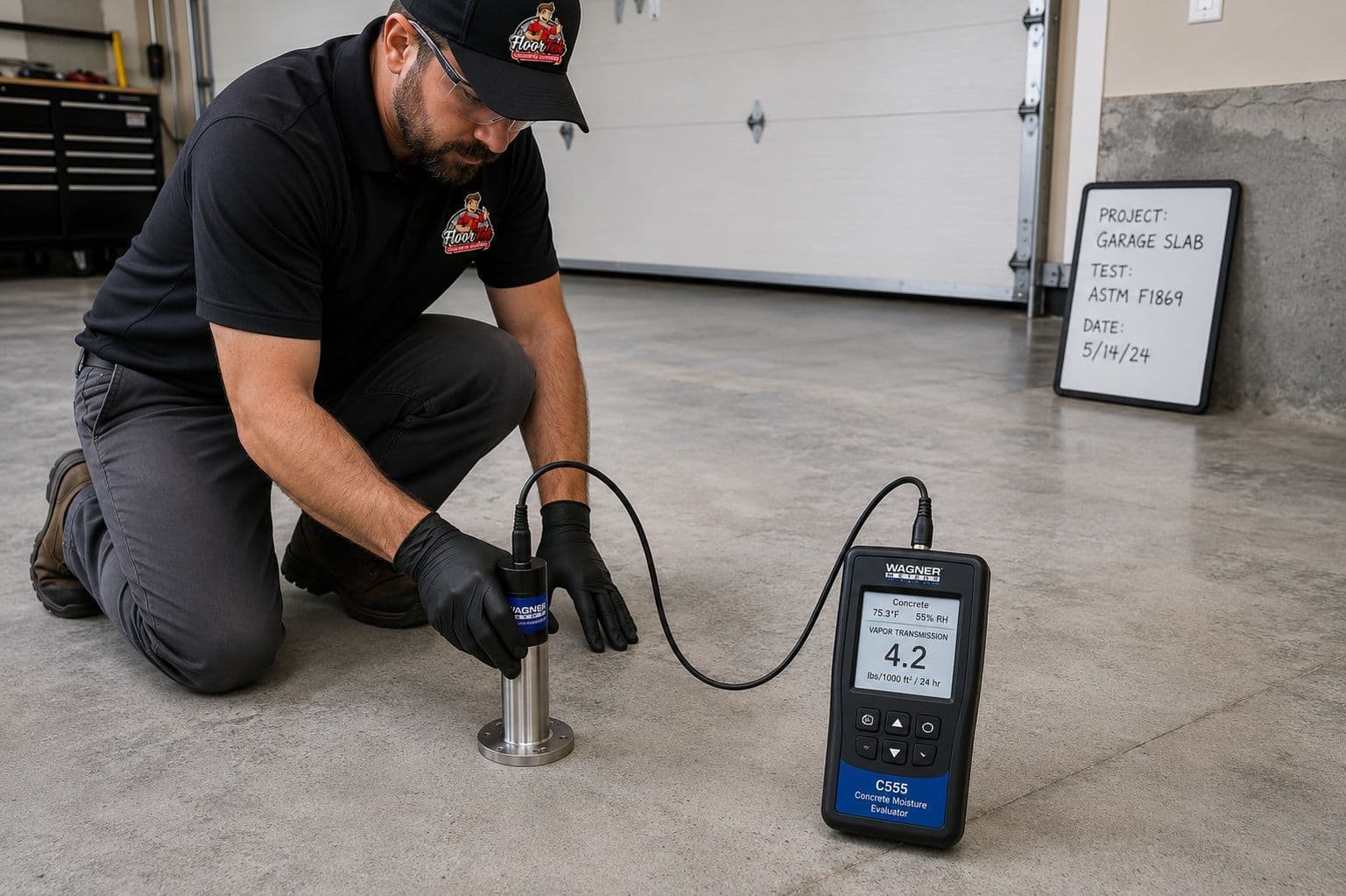
We never guess when it comes to moisture. To establish technical authority and ensure a flawless application, we rely on precise, quantitative data. Before applying any coating, we test the slab using industry-recognized standards established by organizations like the American Society for Testing and Materials (ASTM). The two most common tests we use are the Calcium Chloride Test (ASTM F1869) and the Relative Humidity Probe Test (ASTM F2170).
The Calcium Chloride Test (ASTM F1869): This test measures the specific weight of moisture that escapes from the slab surface. We place a small dish of anhydrous calcium chloride under a sealed plastic dome for 60 to 72 hours. The salt absorbs the escaping vapor, and we weigh the dish afterward to calculate the exact moisture vapor emission rate.
The Relative Humidity Probe Test (ASTM F2170) measures the internal moisture content deep within the concrete slab. We drill a small hole into the concrete, insert a specialized electronic probe, and measure the internal relative humidity over time.
By utilizing these factual data points, we can determine exactly how much moisture your floor is emitting. If you want to read more about these exact industry benchmarks, check our detailed guide on Concrete moisture vapor transmission rates.
The Floortek Polyaspartic Solution: Built to Outperform Epoxy
Our polyaspartic coatings represent the pinnacle of modern flooring technology. Polyaspartic is 10X stronger than standard epoxy, giving it unmatched durability against both physical wear and sub-slab pressures. Because of how the material cures, polyaspartic molecules form a tighter, more resilient network. You can read about the incredible load-bearing capabilities of this material in our technical post on the Tensile strength of polyaspartic vs epoxy.
To ensure these molecules grab hold tightly, we always perform rigorous mechanical preparation. We use industrial diamond grinders to open up the concrete pores. This process is detailed further in our article on Concrete surface profiling for polyaspartic adhesion. Once the surface is profiled, we apply our high-performance polyaspartic system. This system penetrates deep into the concrete's open pores, forming a strong mechanical lock. You can discover exactly how polyaspartic molecules bond with concrete to create an unbreakable connection.
When you choose us, you get a premium flooring system packed with essential benefits:
1-Day Installation: Our advanced formulas cure rapidly. We can fully prep, coat, and hand back your floor in just a single day. Read the scientific breakdown of this fast turnaround time in our article on the science of the Polyaspartic rapid-curing process.
UV Stable: Our coatings are completely aliphatic, meaning they will never yellow, fade, or chalk under the intense Texas sun. Read the data on this in our report on Aliphatic polyurea UV stability technical data.
Chemical Resistant: Our floors resist harsh automotive fluids, solvents, acids, and household cleaners effortlessly.
Manufacturer-Direct Value: We manufacture and apply our products in-house, eliminating intermediaries to deliver the highest-quality materials at the best value.
We bring this elite technology to every project we touch. Whether you require a residential garage upgrade through our Floor Coating Service, a durable driveway coating through our Driveway Coating Service, a refreshed walkway through our Sidewalk Coating Service, or a damp-resistant layer through our Basement Coating Service, we have the exact solution for your property. You can explore our wide array of visual designs on our Colors and Flake Options page, or view our full line of materials on our Our Coating Products page.
We stand behind our work completely. We proudly offer an exclusive 30% off first installation discount to help you get started. We also provide a comprehensive Life-of-home warranty, giving you ultimate peace of mind that your floor will stay beautiful and intact. Ready to protect your concrete slab from underground moisture damage? Contact us today or call us directly at 844-844-4164 to schedule your professional concrete moisture evaluation.
Frequently Asked Questions:
Do high Concrete moisture vapor transmission rates cause garage floor coating peeling in Houston, Texas?
Yes, high moisture levels peel standard coatings. Vapor pressure pushes upward through porous concrete floors. Floortek Coatings uses advanced polyaspartic formulas to resist this movement. This helps stabilize Concrete moisture vapor transmission rates under your floor. You can read about Texas coastal soil hydrology on the Texas Water Development Board website.
How do Concrete moisture vapor transmission rates affect commercial polyaspartic floor installations in Dallas, Texas?
High vapor emission rates can lift weaker coatings, such as epoxy, from the concrete surface. Floortek Coatings applies specialized polyaspartic systems that easily handle these pressures. Our system effectively manages Concrete moisture vapor transmission rates. Learn more about regional slab construction guidelines from the Texas A&M Engineering Extension Service.
Can a polyaspartic patio coating handle high Concrete moisture vapor transmission rates in Austin, Texas?
Yes, polyaspartic coatings are designed to manage sub-slab vapor pressures. Floortek Coating delivers a polyaspartic system that withstands environmental shifting. This system mitigates high rates of concrete moisture vapor transmission through concrete in central Texas. Read about Austin area soil traits through the University of Texas at Austin.
Will high Concrete moisture vapor transmission rates ruin a polyaspartic pool deck coating in San Antonio, Texas?
No, our polyaspartic coatings tolerate vapor emissions much better than traditional epoxy. Floortek Coatings prepares the slab mechanically to ensure deep penetration. This deep bond counteracts the forces of high Concrete moisture vapor transmission rates. Check out regional water table statistics at the San Antonio Water System.
Do Concrete moisture vapor transmission rates increase in Fort Worth, Texas during rainy seasons?
Yes, heavy rain saturates clay soils and increases sub-slab vapor drive. Floortek Coating blocks install a specialized vapor barrier layer when needed—this layer blocks concrete moisture vapor from damaging your polyaspartic finish. Review North Texas weather data via the National Weather Service.
Does polyaspartic flooring breathe enough to survive high Concrete moisture vapor transmission rates in El Paso, Texas?
No, polyaspartic coatings form an impermeable seal rather than breathing. However, Floortek Coatings creates an intense mechanical bond that resists peeling. This prevents high Concrete moisture vapor transmission rates from lifting the floor. Learn about desert soil compositions from the University of Texas at El Paso.
Can Corpus Christi garage floors handle polyaspartic coatings given high Concrete moisture vapor transmission rates?
Yes, coastal concrete slabs can be coated successfully using polyaspartic technology. Floortek Coatings tests every slab to determine the current vapor emission levels. We then apply solutions tailored to local Concrete moisture vapor transmission rates. Explore coastal environmental studies at Texas A&M University-Corpus Christi.
How do you lower Concrete moisture vapor transmission rates before applying polyaspartic in Lubbock, Texas?
We apply a dedicated moisture mitigation primer layer to the raw concrete slab. Floortek Coatings uses this layer to choke off open capillaries in concrete. This process safely controls the Concrete moisture vapor transmission rates under your polyaspartic floor. Read about High Plains geological data via Texas Tech University.
Do modern polyaspartic coatings fail like epoxy under high Concrete moisture vapor transmission rates in Arlington, Texas?
No, polyaspartic coatings rarely fail because they are significantly stronger and more flexible than epoxy. Floortek Coatings designs floors to withstand intense sub-slab vapor pressures. Our specialized system successfully controls Concrete moisture vapor transmission rates. See local structural engineering resources via the University of Texas at Arlington.
Is a vapor barrier necessary for polyaspartic floors if Concrete moisture vapor transmission rates are low in Galveston, Texas?
No, a specialized vapor barrier is not always required if tests show low emission levels. However, Floortek Coatings evaluates every site because coastal moisture levels fluctuate wildly. We always ensure your polyaspartic system matches local Concrete moisture vapor transmission rates. Read about island water table management at the City of Galveston.