Engineering Authority Report: The Tensile strength of polyaspartic vs epoxy in Resin Floor Systems
When you select a protective coating for your concrete floors, evaluating the tensile strength of polyaspartic vs epoxy is the most critical decision you will make. The tensile strength of polyaspartic vs epoxy determines how your floor responds to heavy vehicle traffic, structural shifting, and intense physical impacts over time. At Floortek Coatings, we engineered our advanced polyaspartic floor systems to deliver maximum mechanical resilience. Traditional epoxy options often crack under stress, but our state-of-the-art coatings withstand harsh environmental conditions. We provide this technical guide to present the verified science, testing data, and architectural facts you need to choose the ultimate floor protection.
Physical Properties and the Tensile Strength of polyaspartic vs. Epoxy
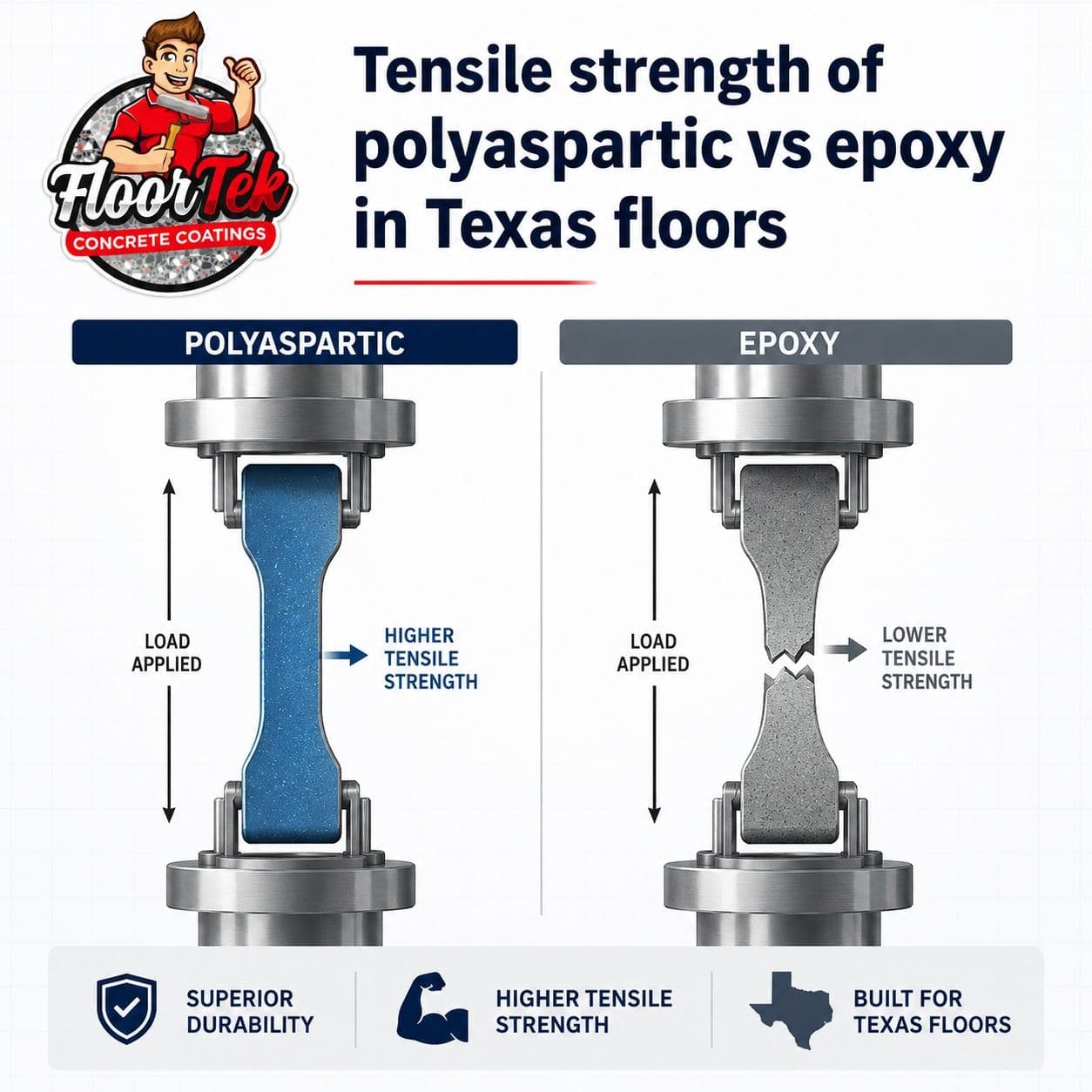
To understand why a floor coating succeeds or fails, you must look at how it handles mechanical tension. Tensile strength measures a material's ability to withstand pulling or stretching forces without breaking. When heavy vehicles park on a floor or when heavy machinery turns across a surface, it creates intense lateral tension.
Industrial testing uses strict ASTM standards to measure these forces. In standard cross-section testing, polyaspartic formulas consistently outperform traditional epoxy. Epoxy coatings are rigid and brittle. They have low elongation, meaning they cannot stretch as the underlying concrete flexes. Our polyaspartic systems combine exceptionally high tensile strength with superior flexibility. This unique combination allows the coating to absorb mechanical energy and distribute it across the surface rather than snap.
Molecular Architecture: Polyaspartic vs. epoxy chemical structure
The root differences in floor performance start at the atomic level. Standard epoxy relies on a cross-linked structure typically formed by mixing a bisphenol-A resin with a cycloaliphatic amine hardener. This reaction creates a highly dense, rigid polymer matrix. While this matrix provides decent hardness, it leaves the material vulnerable to brittle failure. If you apply sudden stress to an epoxy floor, the rigid molecular chains cannot move, causing immediate micro-cracking.
In contrast, the chemistry of polyaspartic coatings relies on an aliphatic polyurea backbone. The ester-modified diamines react precisely with aliphatic polyisocyanates. This advanced configuration creates a flexible urea linkage that maintains high cohesive strength. The polymer chains can shift slightly under load and then return to their original shape. This flexibility is why polyaspartic is 10X stronger than epoxy under dynamic impact and shear stress.
How Environmental Stress Affects Texas Concrete Foundations
Operating a facility or maintaining a home in Texas presents unique challenges for concrete. Regions like Houston and Dallas feature highly expansive clay soils. These soils expand rapidly when wet and shrink drastically during hot summer droughts. This movement causes continuous shifting, bending, and settling in concrete slabs.
Furthermore, extreme temperature swings in cities like Austin, San Antonio, and Fort Worth cause concrete to expand and contract daily. If your floor coating cannot flex along with the concrete, the bond will fail. Brittle epoxy finishes quickly fracture over these moving joints and micro-cracks. Our polyaspartic coatings are engineered to handle continuous thermal expansion and contraction. The coating works in harmony with your Texas foundation, preventing delamination and maintaining structural integrity year-round.
Substrate Preparation: Concrete surface profiling for polyaspartic adhesion
A coating is only as reliable as its bond to the substrate. To achieve a permanent mechanical lock, we perform meticulous concrete preparation before applying any material. We utilize industrial diamond grinding equipment to open up the concrete pores and remove weak laitance. This process creates a specific rough texture known in the industry as a Concrete Surface Profile (CSP).
When we apply our liquid polyaspartic to a properly prepared surface, it achieves incredible penetration. The polyaspartic rapid-curing process, enabled by science, allows the material to wet out the concrete completely before cross-linking. The molecules rapidly sink deep into the open pores of the concrete. This deep penetration creates an unbreakable mechanical root system. You can learn more about how we analyze these deep chemical connections by exploring how polyaspartic molecules bond with concrete.
Managing Moisture: Concrete moisture vapor transmission rates
Moisture is a major threat to any resinous floor system. Ground moisture continuously migrates upward through concrete slabs via capillary action. This phenomenon creates upward pressure on the underside of your floor coating. If the vapor pressure exceeds the coating's adhesion strength, bubbles and blisters will form.
When it comes to moisture, we need to add an extra layer called a vapor barrier. This specialized moisture mitigation layer blocks upward vapor transmission and protects the system from osmotic blistering. By applying this critical barrier, we ensure that the high tensile strength of the top layers remains completely unaffected by sub-slab moisture pressures. This technical step is essential for long-term durability in high-humidity areas across Texas.
The Performance Limits of Standard Epoxy Coatings
While epoxy has been used for decades, its mechanical limitations are well-documented in modern materials science. Epoxy degrades rapidly when exposed to sunlight. Solar radiation breaks down the aromatic rings within standard epoxy molecules, causing severe yellowing, chalking, and loss of gloss. This makes epoxy an unacceptable choice for outdoor applications or areas near garage windows.
Epoxy also suffers from long curing times, often requiring several days before you can walk or park on it. During this extended open time, the wet epoxy is highly vulnerable to dust contamination, insect damage, and moisture interference. Furthermore, epoxy is prone to a failure known as hot tire pickup. When hot car tires park on an epoxy surface, the heat softens the polymer, causing the material to peel off the floor when the vehicle moves.
Technical data on aliphatic polyurea UV stability confirm
Our high-performance polyaspartic systems are designed to eliminate the flaws of old-fashioned epoxy. We formulate our products to provide superior strength, convenience, and long-term value.
1-Day Installation: Our advanced chemical engineering allows for a rapid cure time. We can complete the entire grinding, coating, flake broadcast, and topcoat process in a single day. You can return to full service within 24 hours.
UV Stable Coating: The technical data for aliphatic polyurea UV stability confirms that our coatings do not degrade under intense sunlight. Your floor will maintain its crystal-clear clarity and vibrant color without ever yellowing.
Chemical-Resistant Protection: Our cross-linked topcoats are highly resistant to chemicals. They repel harsh automotive fluids, industrial solvents, acids, and alkalis, preventing staining and chemical degradation.
Life-of-Home Warranty: We stand behind our engineering with an industry-leading life-of-home warranty, giving you complete peace of mind.
Manufacturer-Direct Value: We eliminate middleman markups by managing our product pipeline directly, ensuring you receive premium materials at competitive rates.
Special Promotion: Take advantage of our current offer and receive 30% off the first installation for your property.
Mechanical Performance Comparison: Polyaspartic vs. Epoxy
To clearly understand the tensile strength of polyaspartic vs epoxy, let us review the performance attributes of each material side by side:
Polyaspartic delivers exceptional tensile strength combined with high elongation; epoxy offers high hardness but is completely brittle under tension.
Polyaspartic retains its appearance because it is completely UV-stable; epoxy turns yellow and chalks when exposed to solar radiation.
Our polyaspartic system allows for a convenient 1-day installation; epoxy requires three to five days of curing before you can use the space.
Polyaspartic remains highly flexible in freezing winters and scorching summers, whereas epoxy cracks easily when the underlying concrete moves or settles.
Our polyaspartic forms a deep, tenacious mechanical root system within the concrete pores; epoxy sits on the surface, making it prone to peeling and hot-tire pickup.
If you want to view real-world examples of these high-performance systems in action, feel free to browse our online Floortek Gallery. To discover more about our corporate background and technical mission, you can read About Us. We invite you to explore our comprehensive suite of services, including specialized garage, patio, pool deck, driveway, sidewalk, and Basement coating services. You can find your nearest certified installation team on our Floortek Locations page, or view our beautiful aesthetic options in the Colors and Flake Options catalog. For a deeper look at our material formulations, check out our Coating Products.
Frequently Asked Questions:
How does the tensile strength of polyaspartic vs epoxy affect heavy vehicle traffic on Texas garage floors?
The tensile strength of polyaspartic vs. epoxy indicates that polyaspartic resists cracking under heavy vehicle loads, whereas brittle epoxy fractures easily. Floortek Coatings installs advanced polyaspartic systems that handle extreme weight distribution. For comprehensive data on structural material testing and polymer performance, you can consult the National Institute of Standards and Technology.
Does the tensile strength of polyaspartic vs epoxy prevent cracking over concrete joints in Dallas?
Yes, the superior elongation and tensile strength of polyaspartic vs epoxy allow polyaspartic to bridge moving concrete joints without cracking. Floortek Coatings uses flexible polyaspartic to accommodate the soil shifts common in North Texas. You can review concrete joint guidelines via the Texas Department of Transportation.
Why does the tensile strength of polyaspartic vs epoxy make polyaspartic superior for Houston warehouses?
Polyaspartic polymers withstand high multi-directional shear stress, whereas epoxy fails and deforms under continuous industrial forklift traffic. Floortek Coatings provides high-tensile polyaspartic tailored for heavy commercial demands. Learn more about industrial flooring standards through Texas A&M University.
Does a higher tensile strength of polyaspartic vs. epoxy prevent hot-tire pickup in Austin?
Yes, the exceptional thermal tolerance and tensile strength of polyaspartic vs epoxy prevent polyaspartic from softening and peeling under hot tires. Floortek Coatings applies polyaspartic formulas that resist high chemical and thermal tension. For material science insights, visit the University of Texas at Austin.
How does the tensile strength of polyaspartic vs epoxy impact long-term durability in San Antonio?
Polyaspartic maintains its high tensile elasticity for decades, while epoxy grows increasingly brittle and eventually delaminates from the substrate. Floortek Coatings delivers durable polyaspartic options built for long-term structural stability. Check out structural preservation data on the Texas Historical Commission website.
Is the tensile strength of polyaspartic vs epoxy affected by extreme summer heat in Fort Worth?
No, polyaspartic retains its structural integrity and tensile elasticity in extreme heat, whereas epoxy softens and loses its mechanical bond. Floortek Coatings engineers polyaspartic to withstand harsh southern climate variations. Explore climate impact studies through the Texas Commission on Environmental Quality.
Does the tensile strength of polyaspartic vs epoxy ensure better impact protection on outdoor patios?
Yes, the combination of high impact resistance and tensile strength of polyaspartic compared to epoxy allows polyaspartic to absorb the impact of dropped tools without chipping. Floortek Coatings installs weather-resilient polyaspartic that outperforms old-fashioned epoxy systems. You can read engineering safety articles on the Occupational Safety and Health Administration portal.
Why does the tensile strength of polyaspartic vs epoxy matter for commercial spaces in El Paso?
Commercial spaces experience constant foot traffic and rolling loads that tear low-tensile epoxy apart, while high-tensile polyaspartic remains flawless. Floortek Coatings deploys polyaspartic systems that handle rigorous commercial wear. Review public facility maintenance standards on the Texas Department of Licensing and Regulation website.
Does the tensile strength of polyaspartic vs epoxy relate to chemical resistance in automotive shops?
Yes, the tight cross-linking that creates the high tensile strength of polyaspartic vs epoxy also prevents corrosive chemicals from penetrating polyaspartic. Floortek Coatings applies chemical-resistant polyaspartic to protect concrete against harsh fluids. Learn about chemical safety via the Environmental Protection Agency.
Can you upgrade a failing epoxy floor to high-tensile polyaspartic in Corpus Christi?
Yes, we can grind away failed, brittle epoxy and replace it with a superior high-tensile polyaspartic floor system. Floortek Coatings specializes in removing old coatings and installing premium polyaspartic. For coastal infrastructure guidelines, visit the Texas General Land Office.
Ready to Transform Your Floors?
Protect your concrete investment with the ultimate polymer technology. Our team is ready to deliver a beautiful, chemical-resistant floor with our convenient 1-day installation process. Contact Floortek Coatings today to claim your 30% off first installation and secure our comprehensive Life-of-Home warranty. Give us a call directly at 844-844-4164 or visit our Contact Us page to schedule your expert technical consultation right now!