Polyaspartic Floor Coating vs Epoxy in Houston, Texas: Why One Fails in Our Humidity
When you start researching polyaspartic floor coating vs. epoxy in Houston, Texas, you aren't just comparing two different chemical mixtures; you are looking for a solution that can withstand the Gulf Coast climate. At Floortek Coatings, we speak to homeowners every day who are tired of looking at cracked, peeling, or yellowing concrete. You take pride in your home, and you deserve a floor that reflects that value.
Living in Houston, TX, brings specific challenges—namely, high humidity, intense UV exposure, and shifting clay soil. These factors make choosing between polyaspartic and epoxy floor coatings in Houston, Texas, the most critical decision you will make for your garage, patio, or driveway. We're here to help you cut through the noise and explain why the traditional epoxy route often leads to disappointment in our region, so please feel confident in your choice.
The Houston Factor: Why Geography Dictates Your Floor Choice
If we lived in a dry, temperate climate, the debate regarding polyaspartic floor coating vs epoxy might be different. But we don't. We live in an area known for sudden temperature swings and air thick with moisture.
The primary reason we advocate for polyaspartic floor coating is that homeowners can trust it, given the soil beneath our feet. Houston sits on expansive clay soil. According to geological data from Texas A&M University, this soil swells when wet and shrinks when dry. This constant movement puts stress on your concrete slab.
Here is where the polyaspartic vs. epoxy in Houston, Texas, comparison becomes clear. Epoxy is rigid and prone to cracking. Think of it like a sheet of glass glued to your floor. When your foundation shifts even a fraction of an inch—which is common in neighborhoods from Katy to The Woodlands—epoxy cannot flex. It cracks. Once it cracks, moisture gets in, and the peeling begins.
Polyaspartic, on the other hand, is flexible. It penetrates the concrete and moves with it. It is 10X better than epoxy because it bonds structurally while retaining enough elasticity to bridge minor hairline fractures caused by our shifting ground.
The Problem with Epoxy in the Gulf Coast
Epoxy has been the standard for years, and you will see plenty of DIY kits at places like Floor Decor in Houston, Texas. However, professional-grade floor coating is not the same as paint you roll on over a weekend.
When discussing polyaspartic floor coating vs. epoxy in Houston, Texas, we have to talk about curing. Epoxy takes days to cure. In our humid environment, moisture in the air can settle into the uncured epoxy, causing a reaction known as "amine blush." This leaves the finish looking cloudy, greasy, or patchy before you even drive your car on it.
Furthermore, epoxy is not UV stable. If you leave your garage door open to enjoy the afternoon sun, or if you apply it on a patio, UV rays will degrade the binder. Over time, that beautiful gray or tan floor turns an ugly shade of amber yellow. This is a chemical breakdown, and it means the floor is failing.
Our polyaspartic floor coating vs epoxy in Houston, Texas. Analysis shows that polyaspartic is aliphatic, meaning it is 100% UV-stable. It will never yellow, regardless of how much Texas sun hits it.
What is Polyaspartic Coating?
What is this material? Polyaspartic is a subset of polyurea. Initially developed for industrial applications like protecting steel bridges from corrosion and lining oil pipelines, it is engineered for extreme durability. We have adapted this industrial strength for residential use.
When you choose Floortek Coatings, you are getting a system that:
Cures Rapidly: We offer 1-day garage floor coatings. You can walk on it for hours and park on it the next day.
Bonds Aggressively: It wicks deeply into the concrete pores (via capillary action) rather than just sitting on the surface.
Resists Heat: It will not peel up during "hot tire pickup," a common issue in which hot tires melt low-quality epoxy, causing it to pull off the concrete.
Our Installation Process: The Floortek Difference
We believe that a coating is only as good as the preparation. Many competitors or DIY instructions suggest an acid wash. In Houston, adding more water to your concrete via acid washing is a mistake because the high humidity prevents it from drying completely. Trapped moisture is the enemy of adhesion.
Our process for Houston, Texas, Floor Coating Service Involves:
Mechanical Grinding: We use heavy industrial diamond grinders to remove the top layer of concrete. This process opens the 'pores' of the slab, similar to sanding wood before staining, which is essential for ensuring a strong, long-lasting bond.
Crack Repair: We repair cracks and divots with specialized fillers compatible with our base coat.
The Base Coat: We apply a pure polyurea base coat that soaks into the concrete.
The Flake: We broadcast Colors and Flake Options Into the wet base coat until rejection (full coverage). This adds texture and strength.
The Top Coat: We finish with a high-solids polyaspartic top coat that resists stains, chemicals, and UV rays.
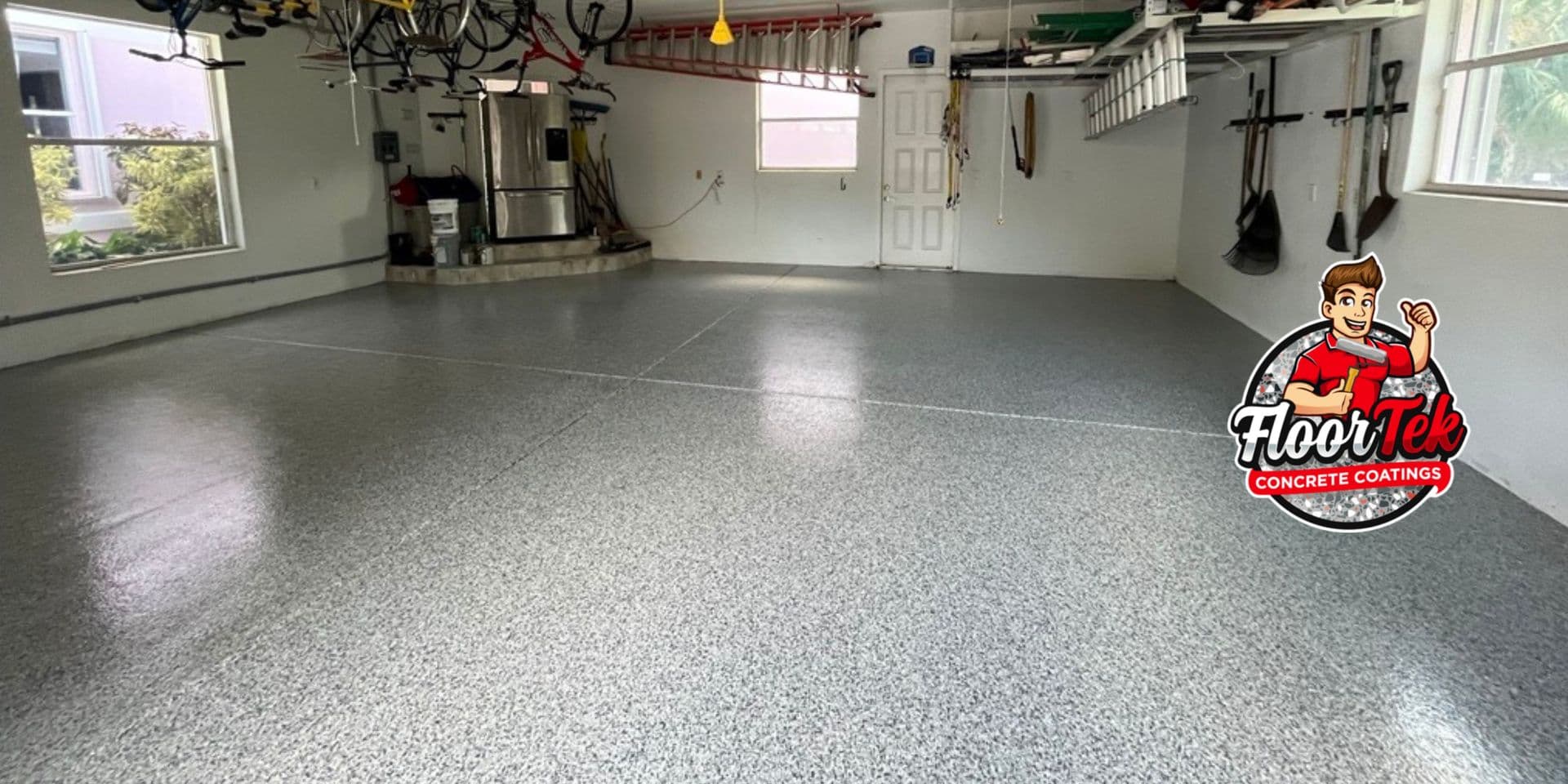
You can see the results of this rigorous process in our Gallery.
Beyond the Garage: Where Else Can It Go?
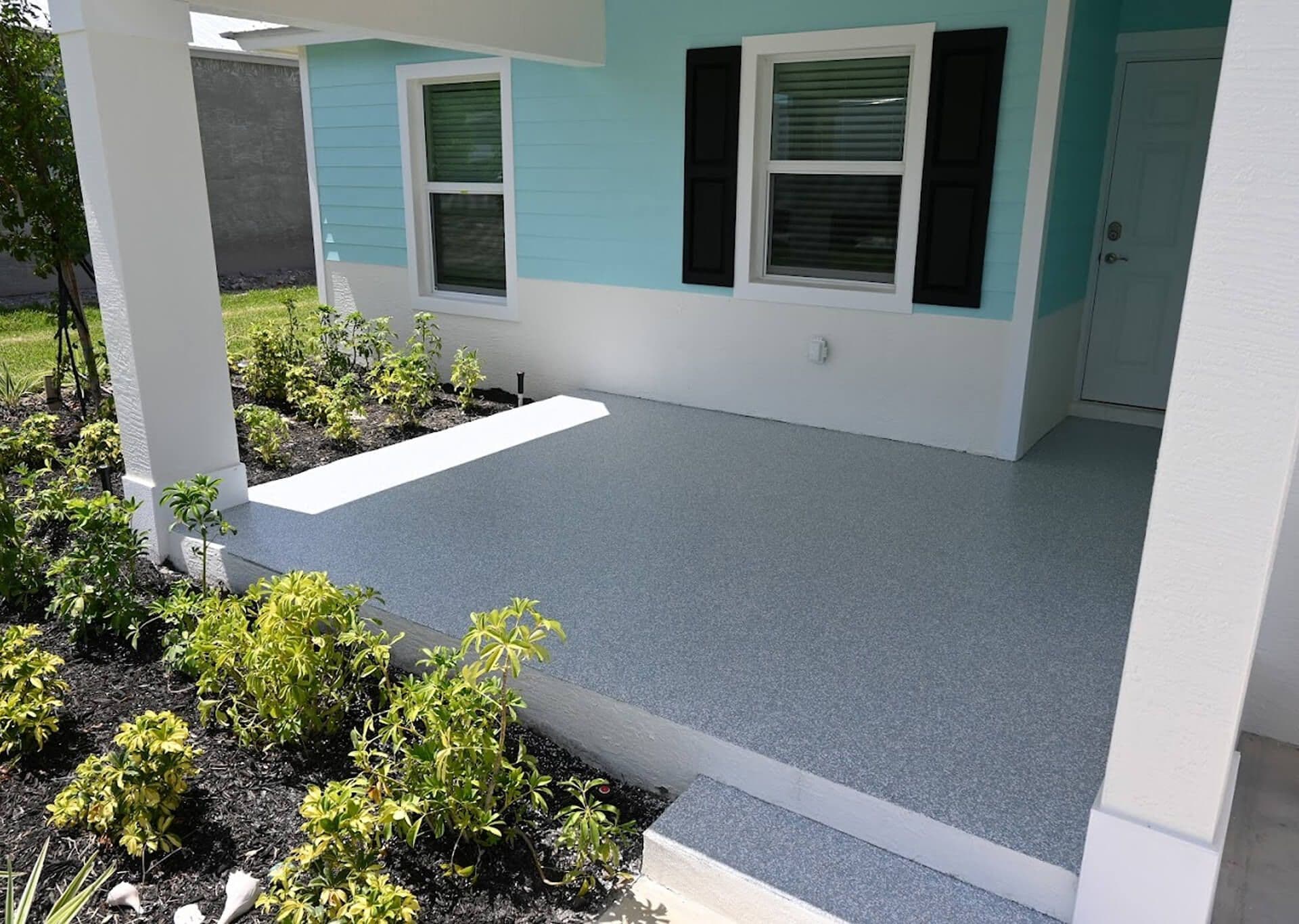
While the garage is the most popular spot, the polyaspartic floor coating vs. epoxy debate in Houston, Texas, extends to your outdoor living spaces. Because our product is UV stable, it is the perfect solution for exterior concrete.
Patio coating: Transform your plain grey concrete patio into a decorative extension of your home. Unlike stamped concrete, which requires annual sealing, our coatings are low-maintenance.
Pool decks coating; Concrete around pools can get dangerously hot and unsightly. Our coatings reduce the surface temperature compared to bare concrete and provide a textured surface for better footing.
Driveway coating: Your driveway is the first thing people see. A chipped, oil-stained driveway ruins curb appeal. Polyaspartic resists oil leaks, gas spills, and tire marks.
Sidewalk coating: Protect your walkways from spalling and weathering damage.
Basement coating: While basements are rare in Houston due to the water table, for those with sunken living areas or lower-level spaces, this coating prevents concrete dusting and creates a clean, sealed environment.
The Cost Perspective: Investment vs. Expense
We know that budget is a factor. When researching epoxy vs. polyaspartic costs in Houston, Texas, you will find that polyaspartic has a higher upfront cost than epoxy.
However, you must consider the lifecycle. An epoxy floor in Houston typically lasts 3 to 5 years before it starts to crack, peel, or yellow significantly. You will then have to pay to remove it (which is labor-intensive) and re-coat it.
Our polyaspartic system is designed to last for decades. We back this confidence with a Life-of-Home warranty. When you amortize the cost over 15 or 20 years, polyaspartic flooring vs epoxy in Houston, Texas becomes the far more economical choice. You pay for it once, and you are done.
Plus, we are currently offering 30% off the first installation. This makes the superior technology more accessible than ever.
Comparing Durability in the Real World
Let’s look more closely at polyaspartic vs. epoxy durability in Houston, Texas. Durability isn't just about how hard the floor is; it's about chemical resistance.
In a garage, your floor faces attack from:
Road salts (rare in Houston, but possible during freezes).
Motor oil and brake fluid.
Gasoline.
Lawn chemicals and fertilizers.
Epoxy is porous on a microscopic level. If you leave gas or oil on it too long, it can stain. Polyaspartic is impervious. You can wipe up spills without worrying about permanent discoloration. This makes it the best coating-for-garage-floors company Houston residents can choose.
Why Generic "Big Box" Solutions Fail
We often hear from customers who tried to save money by buying a kit from Floor and Decor Houston, TX, or other home improvement stores. We have nothing against these stores for tile or wood, but for liquid-applied coatings, consumer-grade products are vastly different from professional-grade products.
These kits usually contain water-based epoxy. It is thin, has low solids content (meaning it shrinks when it dries), and has inferior adhesion. In the humid Houston climate, these DIY floors often begin to peel within 6 to 12 months.
When you look at commercial flooring standards in Houston, TX, you never see water-based epoxy used in high-traffic areas. You shouldn't settle for it in your home, either. Our coating products are 100% solids, meaning what we put down is what stays down—no shrinking, no evaporation.
Local Areas We Serve
We are proud to serve the greater Houston area. Whether you are searching for epoxy garage floor Houston, TX, in Houston, TX, or looking for advanced solutions in Cypress, Sugar Land, Pearland, or Spring, we are your neighbors.
We understand the local architecture and the specific concrete mixes used by Houston builders in different decades. This local expertise allows us to tailor our prep work to your particular slab.
Summary: The Verdict on Polyaspartic Floor Coating vs Epoxy in Houston, Texas
To recap, here is why polyaspartic coating vs epoxy in Houston, Texas results in a clear winner:
Climate Adaptability: Polyaspartic handles humidity and heat; epoxy struggles with them.
Flexibility: It moves with our shifting clay soils, and epoxy cracks.
Speed: We finish in 1 day; the epoxy takes nearly a week to cure fully.
Aesthetics: UV stability ensures no yellowing; epoxy fades.
Don't let your garage floor become a source of frustration. Choose the solution that is engineered for our environment.
Would you be ready to Upgrade Your Floor?
If you are ready to stop worrying about peeling paint and start enjoying a showroom-quality floor, we are here to help. We offer a Free Quote where we come to your home, inspect your concrete's moisture levels and condition, and give you an honest assessment.
Visit our Contact Us page. We're here to help you through the noise and explain why the traditional epoxy route often leads to disappointment in our specific region. Please check our Locations page to find the team nearest you.
Floortek Coatings
4109 Katy Hockley Rd #1, Katy, TX 77493, United States
Please take advantage of our 30% off on the first installation and get a floor backed by a Life-of-home warranty.
Frequently Asked Questions
1. What is the difference between polyaspartic and epoxy floor coatings in Houston, Texas?
Polyaspartic and epoxy floor coatings are chemically distinct. Polyaspartic coatings cure in 24 hours, remain flexible to withstand Houston’s shifting clay soil, and are 100% UV-stable. Traditional epoxy is highly rigid, making it prone to cracking when foundations shift, and it chemically degrades (yellows) under intense Texas sunlight.
2. Can you DIY a polyaspartic floor coating, or do you need a professional?
It is highly recommended to hire a professional company, such as Floortek Coatings, for polyaspartic application. Polyaspartic has an extremely short "pot life," meaning it begins to cure and harden within minutes of mixing. Successful installation requires industrial diamond grinding machinery to open the concrete's pores and a trained, multi-person crew to apply the layers smoothly before the chemical sets.
3. How long does it take to install a professional polyaspartic garage floor?
A professional polyaspartic floor installation by Floortek Coatings takes exactly one day. Unlike traditional epoxy coatings, which require 3 to 5 days of drying time before use, a 1-day polyaspartic system allows homeowners to walk on the surface within hours and safely park vehicles on it the very next day.
4. Does Houston’s high humidity affect polyaspartic or epoxy floor installation?
High humidity severely degrades uncured epoxy, causing a foggy, greasy surface defect known as "amine blush." Conversely, polyaspartic chemistry is highly moisture-tolerant during application. When installed professionally using mechanical diamond grinding rather than a wet acid wash, Houston's humidity will not affect the polyaspartic bond or finish.
5. Is polyaspartic or epoxy better for outdoor concrete surfaces like driveways and patios in Texas?
Polyaspartic is the superior choice for outdoor concrete surfaces—including driveways, patios, walkways, and pool decks—in Texas. Because polyaspartic is an aliphatic compound, it is 100% UV-stable and will not fade, yellow, or chalk in the sun. Traditional epoxy lacks UV stability and will rapidly break down under direct sunlight.
6. What causes an epoxy garage floor to peel or fail in Houston?
Epoxy floors in Houston typically fail due to two regional factors: upward hydrostatic moisture pressure driven by high humidity, and hot-tire pickup, where heated car tires melt and lift low-quality epoxy from the slab. Peeling is also accelerated by poor surface preparation, such as using a DIY acid wash instead of professional mechanical diamond grinding.
7. Are polyaspartic floor coatings high in VOCs, or do they have a strong chemical odor?
Floortek Coatings uses high-solids polyaspartic formulas that are low-VOC and environmentally compliant. While there is a mild, distinct scent during the brief installation window, the odor dissipates entirely within a few hours. This makes it much safer and less disruptive than the harsh, pungent, and long-lasting chemical fumes associated with solvent-based epoxies.
8. What is the best way to clean and maintain a polyaspartic concrete floor?
Cleaning a polyaspartic floor requires minimal maintenance because its non-porous surface is impervious to stains, oils, and chemicals. For routine cleaning, use a broom or dust mop to remove loose debris. For deeper cleans, use a squeegee or mop with a mixture of mild, non-filming soap and water. The floor never requires waxing, polishing, or re-sealing.
9. Is a polyaspartic floor coating worth the extra cost compared to epoxy?
Yes, polyaspartic flooring is highly cost-effective over its lifecycle. While polyaspartic has a higher upfront installation cost than standard DIY epoxy kits, a traditional epoxy floor in Houston typically cracks, peels, or yellows within 3 to 5 years. Floortek Coatings provides a Life-of-Home warranty on their polyaspartic systems, making it a one-time investment that saves money on removal and re-coating costs over several decades.
10. What color options and finishes are available for polyaspartic garage floors?
Floortek Coatings offers a wide variety of customizable colors and decorative vinyl flake options. Homeowners can choose from distinct multicolored blends engineered to mimic the premium, textured aesthetic of natural granite, terrazzo, quartz, or stone, seamlessly complementing any home style.
For more information on concrete humidity and care, you can visit the American Concrete Institute.